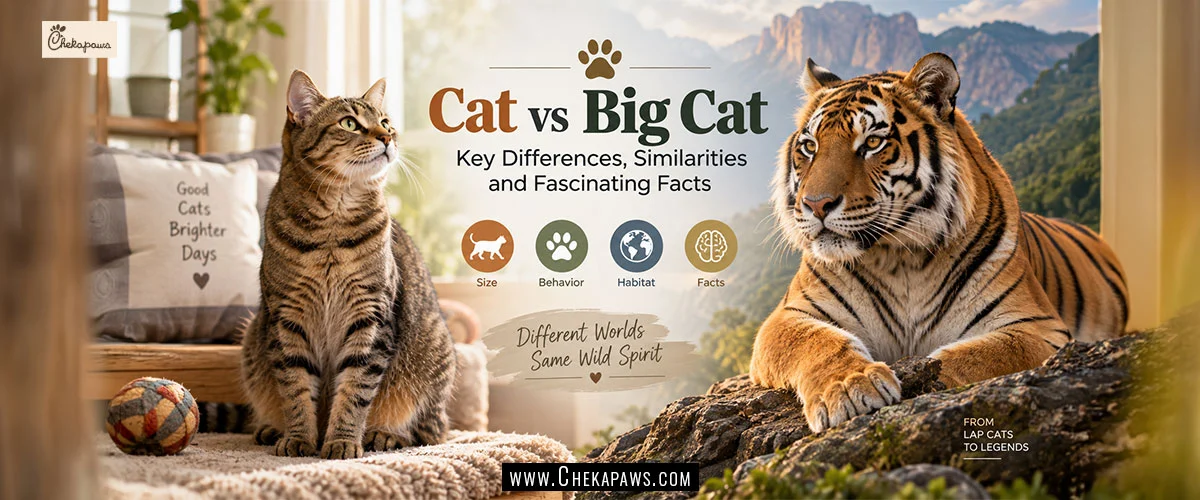
Have you ever wondered how closely your pet cat resembles lions, tigers, leopards, and other large cats? Big cats and domestic cats have many unexpected traits in common, despite their vastly different sizes and lifestyles.
While a tiger wanders through grasslands or woodlands in search of prey, a domestic cat might spend the afternoon dozing off on the couch. However, they are also members of the Felidae family, which indicates that they have a similar evolutionary history.
What distinguishes a huge cat from a domestic cat, then? Are they truly so alike? Is your cute home cat a tiny version of a wild cat?
Let’s investigate the intriguing world of huge cats vs cats.
Table of Contents
Cat vs Big Cat: What’s the Difference?
Size is the most noticeable difference between a huge cat and a domestic cat. But size isn’t the only difference.
For thousands of years, domestic cats (Felis catus) have coexisted with people as companion animals. Large wild felines like lions, tigers, leopards, and jaguars are commonly referred to as “big cats.”
Domestic cats are much smaller and have evolved to live in close proximity to people, whereas big cats have robust bodies designed for hunting large prey.
Quick Comparison: Domestic Cats vs Big Cats
| Feature | Domestic Cat | Big Cats |
|---|
| Scientific classification | Felis catus | Several species within Felidae |
| Typical size | Small | Medium to very large |
| Habitat | Homes, farms, urban areas | Forests, grasslands, mountains and other wild habitats |
| Diet | Carnivorous | Carnivorous |
| Hunting | Small prey | Often larger prey |
| Social behavior | Varies by individual | Depends on species |
| Relationship with humans | Domesticated | Wild |
| Communication | Meows, purrs, hisses, body language | Roars, growls, vocalizations and body language |
Domestic Cats and Big Cats Belong to the Same Family
The idea that your home cat is actually connected to wild cat is among the most fascinating facts about cats.
The Felidae cat family, which contains many species of wild cats, includes domestic cats.
Because of their common lineage, domestic cats can exhibit behaviors that are very similar to those of lions, tigers, leopards, and other wild cats.
Both domestic and wild cats, for instance, may:
- Stalk their prey
- Pounce suddenly
- Groom themselves
- Stretch after resting
- Mark territory
- Scratch surfaces
- Use body language to communicate
- Hide when they feel threatened
- Spend considerable time sleeping
In a very basic sense, your cat is exhibiting behavior related to its predatory history as it chases a toy mouse across the living room.
Size Is the Biggest Visible Difference
A huge cat and a domestic cat are very different in size.
Although the weight of particular breeds and cats varies greatly, an average domestic cat weighs only a few kilograms. Big cats have significantly higher muscle mass and can weigh many times more.
For instance, the body of a tiger is built to defeat enormous prey. It is a highly skilled predator thanks to its strong jaws, huge paws, robust limbs, and muscular shoulders.
That degree of physical strength is not necessary for domestic cats. Their little stature makes them ideal for capturing rodents and birds.
Why Are Big Cats So Large?
When hunting and vying for food, large bodies might provide wild predators an advantage.
Big cats might have to
- Chase or catch larger prey
- Protect areas
- Compete with other predators
- Travel Long Distance
- Survive in difficult situations
Because humans offer food, shelter, and protection, domestic cats face quite different survival pressures.
Both Are Carnivores
The diet of big cats and domestic cats is one of their biggest similarities.
As obligate carnivores, cats’ bodies are designed to get vital nutrients from diets derived from animals.
While wild cats get their nourishment by hunting animals, domestic cats may consume specially prepared commercial cat chow that has the nutrients they need.
Although their hunting tactics can differ significantly, there are significant biological parallels between them.
Why Do Cats Have Sharp Teeth and Claws
Cats are able to catch and eat animals thanks to their physical adaptations.
Among them are
- Sharp teeth
- Retractable claws in domestic cats and many felines
- Powerful jaw muscles
- Excellent hearing
- Strong night vision
- Flexible bodies
- Sensitive whiskers
Your cat’s claws may be tiny compared with a tiger’s, but they serve similar basic functions.
Domestic Cats Hunt Too
You can observe predatory behavior even if you don’t live in the wilderness.
A domestic cat could pursue
- Toys
- Insects
- Birds
- Rodents
- Moving objects
Your cat may be crouching low, observing something intently, creeping slowly, and then abruptly leaping.
This activity is similar to the basic hunting process performed by wild cats.
Why Does My Cat Attack Toys?
For kittens, play is especially crucial because it gives them the chance to practice hunting-related skills.
A ball, toy mouse, or feather wand can motivate your cat to:
Observe → Stalk → Pounce → Grab → Chase
For indoor cats, interactive play can be a great way to provide enrichment.
Their Body Language Has Many Similarities
Vocal noises are not the only means of communication for cats.
Both domestic and wild cats communicate through movement, ears, tails, facial expressions, and body posture.
For example, a cat with
Flattened ears may be frightened, stressed, or defensive.
An arched back may be trying to appear larger or signal discomfort.
A relaxed posture may indicate comfort.
A rapidly moving or twitching tail can indicate heightened emotion or arousal.
Pet owners can better understand their cats’ attempts at communication by being aware of their body language.
Why Do House Cats Meow While Big Cats Roar?
Vocal communication is one of the most obvious differences between domestic cats and some big cats.
Domestic cats are renowned for
- Meowing
- Purring
- Hissing
- Chirping
- Trilling
- Growling
Lions and some other large felines can produce powerful vocalizations, including roaring.
Do All Big Cats Roar?
No.
Not all huge cats are capable of roaring. The physical as well as behavioral adaptations for vocalization vary among feline species.
This serves as a crucial reminder that not all huge cats behave exactly like lions, despite the phrase “big cat” being used.
Domestic Cats and Big Cats Are Both Excellent Groomers
You’ve seen one of the traditional feline manners if you’ve ever seen your cat lick its hair for an extended period of time.
Cats can benefit from grooming in terms of comfort and social behavior in addition to helping to preserve their coats.
Wild cats also groom themselves.
However, depending on the type of coat, a domestic cat may require more maintenance. For instance, frequent brushing may be necessary for long-haired animals in order to minimize mats and tangles.
Both Love to Sleep and Rest
This is another similarity that cat owners will notice right away.
Cats sleep and rest for extended periods of time.
Wild cats also use rest intervals to save energy.
Hunting demands energy spikes for predators. It is possible to preserve that energy by taking a break in between times of exertion.
Therefore, it’s not always a sign of laziness when your cat sleeps for hours in a bright window. Sleeping and resting are typical aspects of cat behavior.
Domestic Cats Are Adapted to Humans
Their relationship with people is the largest difference, not only their size.
After being domesticated, domestic cats have evolved to coexist with people.
They might reside in
Apartments
Homes and Farms
Shelters
Urban areas
They have also developed behaviors that make communication with humans particularly noticeable.
When engaging with humans, cats frequently meow, rub, purr, stare, and engage in other behaviors.
However, big cats are still considered wild creatures. Wild cats maintain their innate wants and behaviors even when raised among people.
Big Cats Have Specialized Hunting Strategies
Depending on their surroundings and prey, several large cat species have evolved distinct hunting strategies.
Tigers
Tigers frequently use ambush and stealth. In shadows and vegetation, their striped coats can help break up their outline.
Lions
Because they live in social groups known as prides, lions are unique among cats. Members of the gang may cooperate when hunting.
Leopards
Leopards are renowned for their ability to climb trees and are extremely versatile predators. Additionally, they might carry victims into trees.
Jaguars
Strong predators connected to American ecosystems are jaguars. They can swim very well and can take on large prey.
Since most domestic cats get food and shelter from people, they don’t require these specific survival methods.
Domestic Cats vs Big Cats: What They Have in Common
Big cats and domestic cats have many feline traits in common, despite their differences.
Shared Traits
Both may have
- Excellent hearing
- Sharp claws
- Strong hunting instincts
- Flexible spines
- Sensitive whiskers
- Strong night vision
- Powerful hind legs
- Grooming behaviors
- Territorial instincts
- Predatory behavior
- Similar forms of body-language communication
These parallels offer an intriguing window into cats’ evolutionary past.
Is a Domestic Cat Basically a Small Tiger?
Not exactly.
A domesticated cat is more than just a little tiger.
Domestic cats and large cats are distinct species with differing adaptations, habits, genetics, and ecological roles, while sharing a common evolutionary ancestor and a number of both physical and behavioral characteristics.
Your cat may stalk a toy just like a small predator, but it lacks a tiger’s size, power, ecological demands, and temperament.
Instead of considering domestic cats and big cats as identical animals that differ only in size, it is preferable to consider them as distant relatives with similar feline traits.
Why Learning About Big Cats Helps Us Understand Pet Cats
Cat owners can gain a greater understanding of their pets’ behavior by studying wild cats.
For instance, it’s easier to comprehend why your cat likes chasing toys if you know that cats are natural predators.
Additionally, you can make your pet’s home more comfortable if you know how important hiding and resting spots are for cats.
Bring the Wild Side Into Safe Indoor Enrichment
You can encourage natural behaviors without exposing your cat to wild environments.
Try:
- Puzzle feeders
- Interactive toys
- Scratching posts
- Cat trees
- Window perches
- Safe hiding places
- Food-search games
- Rotating toys
- Short interactive play sessions
These activities can provide mental and physical stimulation.
Frequently Asked Questions About Cats vs Big Cats
Are domestic cats related to lions and tigers?
Yes. Domestic cats and big cats belong to the Felidae family and share evolutionary ancestry, although they are different species.
What is the biggest difference between a domestic cat and a big cat?
The most obvious difference is body size, but their lifestyles and relationship with humans are also very different. Domestic cats are domesticated companion animals, while big cats are wild felines.
Do domestic cats have the same hunting instincts as big cats?
Domestic cats retain strong predatory behaviors, including stalking, chasing, and pouncing. However, their prey and hunting circumstances are generally very different from those of wild cats.
Can domestic cats roar like lions?
Domestic cats do not produce the same type of roar associated with lions. Their vocal repertoire includes meows, purrs, hisses, chirps, trills, and growls.
Why does my cat act like a wild animal?
Many behaviors that seem “wild,” such as stalking, pouncing, scratching, climbing, and territory marking, are normal feline behaviors. Domestic cats retain many instincts inherited from their wild ancestors.
Are big cats suitable as pets?
Big cats are wild animals with complex physical, behavioral, dietary, and environmental needs. They are not equivalent to domesticated cats and are generally unsuitable as household pets.
Conclusion
Comparing ordinary house cats to their massive wild cousins highlights a fascinating link between the pets on our couches and the predators of the wild.
A domestic feline might be small enough to snooze in your lap, but its anatomy and instincts are shaped by millions of years of shared evolutionary history. Whether they are stalking toys, leaping onto high shelves, grooming their fur, or using subtle body language to communicate, our pets constantly mimic the behaviors of large wild cats.
The next time your cat crouches low behind a chair and springs forward to catch a toy, you are witnessing a miniature version of the hunting instincts that drive the world’s greatest apex predators. They may vary wildly in size, but a shared genetic blueprint unites every single feline.